




- TL; DR: Quick Takeaways
- Picking the Right Garage Size
- Garage Sizes by Uses
- Garage Door Sizes Explained
- Attached Vs. Detached Garages
- What’s the Right Garage Size?
- Let’s Build a Garage You’ll Love!


Your garage is more than a parking spot; it’s an extension of not just your home but also your personality. It speaks for itself. This is your storage hub, workshop, a space full of future potential & ideas, and definitely a home to your cars.
Quick Actions (Fastest Next Steps)
- Design & price online: Use the 3D Building Designer
- Get a Free Quote: https://www.engineeredmetalbuildings.com/contact-us/
- Call Now: (208) 572-1441
- Flexible payments: Financing | Rent-To-Own
TL; DR: Quick Takeaways
Essential facts you should know:
- Single Car: Think of a 12x20 as the absolute tightest fit. It'll do the job, but just barely. If you can, stretch it to a 14x24.
- Two Cars: Yeah, a 20x20 is what everyone builds. If you want a garage that works harder, aim for 24x24.
- Three Cars: A 32x22 works for three sedans. But let's be real, we drive trucks and SUVs now. Do yourself a huge favor and upgrade to 36x24.
- A Word on Doors: If you're going for two cars, fight for two separate 9-foot doors with a solid wall between them.
- Here's the Real Secret: The magic of a great garage isn't its width- it's its depth. That space behind where your bumper stops? That's your gold mine. Plan for extra room back there.
Choosing the right size isn’t just an instinctive decision or squeezing your car in; it’s about creating a functional space that works for your lifestyle and boosts your property’s future value.
Here’s a simple guide to help you understand the available garage sizes, door dimensions, and more, so you can be confident when you plan what fits you best!
Planning Tip (Before You Finalize Size)
Picking the Right Garage Size
Following are the steps that help decide the right garage size for you-Step 1: Measure Your Vehicles
Measure the dimensions of your vehicles and add a 3-foot in front & behind, and 2.5 feet on the sides. This gives ample space for ventilation, easy exit & entry with movable area.
Step 2: Choose Your Door Layout
The functionality of a garage depends hugely upon the entry & exit points. For two cars, options between a 16-foot-wide door or two separate 8-9-foot wide are ideal. Two doors provide a much cleaner look with a supportive center column, curbing weather issues and simplifying repairs.
Step 3: Plan for Depth & Storage Zones
Don't make the number one garage planning mistake: forgetting about the depth. Sure, your car fits now, but where does the lawnmower go? The bikes? The holiday decorations? By adding a few extra feet of depth- 24 to 26 feet total- you create a "buffer zone" at the front or back.
Want a Garage That Doubles as a Shop?
Garage Sizes by Uses
Here’s a detailed breakdown of standard garage sizes and their ideal use cases.1-Car Garage
- Minimal Fit (12'x20'): Fits your car, but that’s it. Getting in and out is a squeeze.
- Comfortable Pick (14'x24'): Room to open doors easily + space along the wall for bikes or storage.
- Door Tip: Go for a 10-foot-wide door- it makes pulling in much easier.
2-Car Garage
- 20x20 feet (Minimum): Fits two cars, but it's a tight squeeze. You'll be climbing out carefully to avoid dinging doors.
- Comfortable/ Recommended Size: 22 ft. x 24 ft. This is a significant improvement, offering more shoulder room between vehicles.
- Family’s Favorite: This is the size that actually works for real life.
- Door: A 16-foot-wide door or, two 9-foot-wide ones.
3-Car Garage
- ‘Standard’ Size: 32 feet x 22 feet. This layout typically fits three cars in a row, but depth can be tight for larger vehicles.
- Better/ Recommended Size: 36 feet x 24 feet. The extra width and depth are worth the investment. It comfortably accommodates three larger vehicles (like trucks and SUVs) and provides essential storage space. T-shaped layouts are also popular for a third bay dedicated to a boat or workshop.
4-Car Garage
- Baseline Size: Starts around 40 feet x 20 feet, but this is highly customizable.
- Common Layouts:
- Parallel (4-in-a-row): A long rectangle, ideal for straightforward parking.
- Double-Deep (Tandem): Two bays deep, perfect for storing seasonal vehicles or creating a dedicated workshop space behind daily drivers.
- With Traffic Lanes: For easy manoeuvring of boats or RVs, include extra width for turning lanes.
Also Read: 30x40 Metal Buildings
Ready to see pricing ranges?
Garage Door Sizes Explained
The right door is as important as the garage itself. Use this [matrix](/garage-door-size-chart) as your guide.- 1 Car: a 9’ or 10’ door’s great.
- 2 Cars: a 16’ door’s standard.
- Door Height:
- Standard: 7 feet. Often too low for modern vehicles.
- Recommended: 8 feet. This is a smart upgrade that easily clears lifted SUVs, trucks with roof racks, and minivans.
Attached Vs. Detached Garages
- Attached Garage: Offers direct access to the home as well as convinience. It offers superior climate control and is usually less expensive to construct. It can, however, be noisy.
- Detached Garage: Offers excellent segregation, perfect for noisy hobby areas, and rental apartments. Prefabricated metal detached garages, are ready in a matter of weeks, and gives you a significant advantage in terms of lead time and construction.
Get Help Choosing the Right Layout
- Get a Free Quote: https://www.engineeredmetalbuildings.com/contact-us/
- Call: (208) 572-1441
What’s the Right Garage Size?
| Garage Type | Minimum Dimensions | Ideal Dimensions | Perfect For |
|---|---|---|---|
| 1-Car | 12' x 20' | 14' x 24' | A single car. |
| 2-Car | 20' x 20' | 24' x 24' | Families with two cars, additional storage. |
| 3-Car | 32' x 22' | 36' x 24' | Bigger families, trucks, or anyone with hobbies or growing needs. |
| 4-Car | 40' x 20' | Custom-made (e.g., 40'x30') | Car collections, boats, or massive equipment or storage. |
Want to lock in a plan today?
- Design it in 3D: https://engineeredmetalbuildings.sensei3d.com/
- Ordering steps: https://www.engineeredmetalbuildings.com/ordering-process/
Let’s Build a Garage You’ll Love!
Getting stuck with a garage that you regret later is a real thing. Use this guide to make an informed choice, or contact us to receive a quote for a space that truly suits your needs.Call: (208) 572-1441
Request a Free Quote
We’re here to guide you, clarify your doubts, and help you choose what’s best for you!
Similar Building Models


- TL; DR: Quick Takeaways
- Picking the Right Garage Size
- Garage Sizes by Uses
- Garage Door Sizes Explained
- Attached Vs. Detached Garages
- What’s the Right Garage Size?
- Let’s Build a Garage You’ll Love!


You don’t have to spend weekends driving from one dealer to another or wait days for someone to call you back. These days, you can buy your metal building without ever leaving home.
The process is online now. Faster. More flexible. And you stay in control from start to finish.
Planning a workshop? Need a garage? Maybe a barn? Ordering online saves time, often saves money, and gives you far more options than most local suppliers can offer.
Why More People Are Buying Online
- Shop whenever it works for you.
- Find better deals, with discounts only offered online.
- See more choices in styles, sizes, and layouts than you’d find in person.
Once you start designing, everything’s laid out clearly. Change the size. Switch the roof style. Test out different colors. Every option is right in front of you. When it looks the way you want, you can place your order on your schedule, no pressure, no waiting.
Seamless Online Shopping Experience
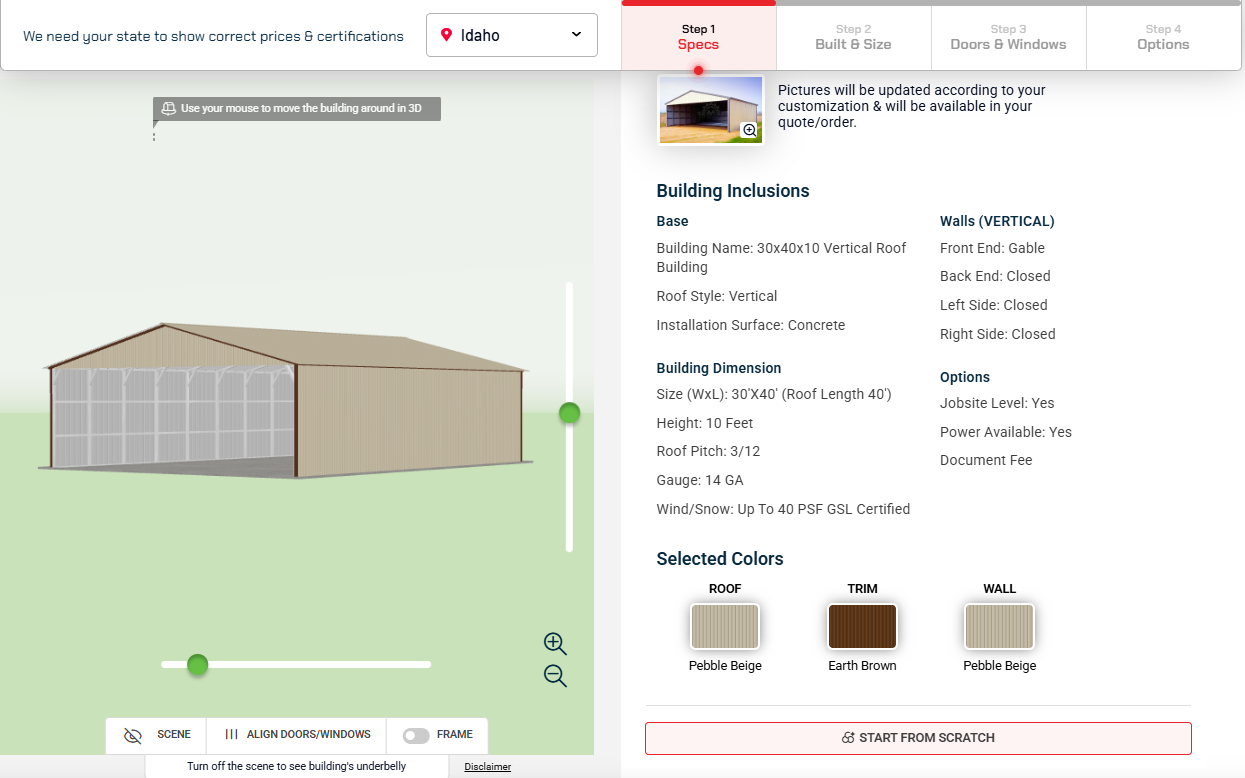
Our e-commerce platform is designed to guide you through the process step by step. First, you choose the type of building you need. From there, every option is user-friendly and clearly builds size, lean-tos, roof style, doors, windows, all with live pricing as you make changes. And when you’re done, the checkout is fast. No forms that ask for the same thing twice. No waiting around.You’ll also be able to follow your progress, from start to confirmation.
What stands out:
- The layout is clear, so you know exactly where to begin.
- Prices update instantly as you change features.
- The entire order process only takes a few minutes once you’re ready
Fully Customizable Metal Buildings
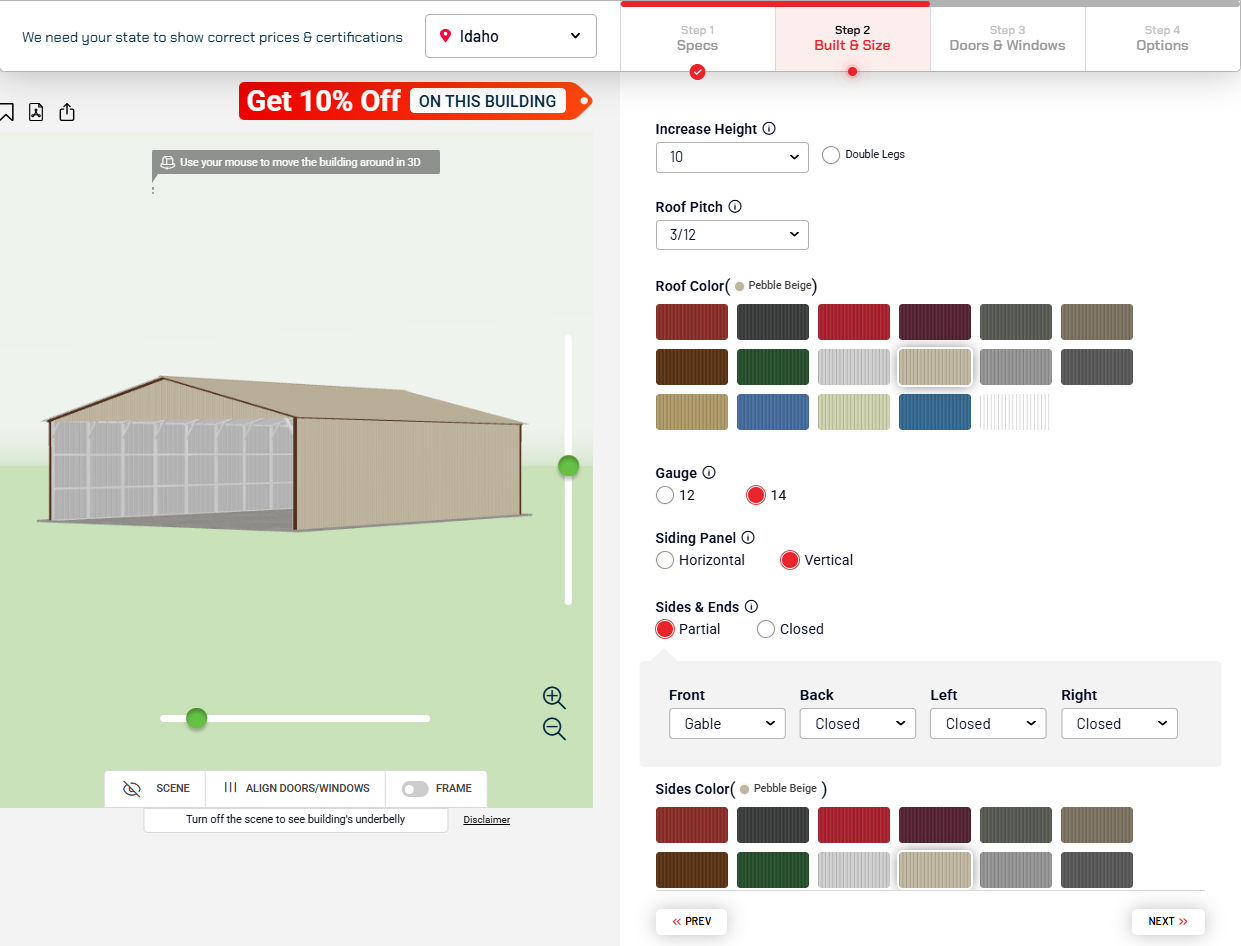
Ordering a metal building online isn’t just convenient; it lets you make it exactly how you want it. No sticking to a handful of pre-set models. No “close enough” designs. You can start small with a backyard shed or go big with a commercial building, and everything in between.
From the first click, you’re in control. Change the size. Pick your roof style. Add the number of doors and windows you need. Adjust the colors until they fit your property perfectly. As you make changes, you’ll see the updates instantly on your screen.
There’s also a 3D design tool built in. You can spin your building around, zoom in on the details, and get a clear picture of what it’ll look like before you place the order.
Want specifics? You can choose dimensions like 30×40 or 40×60, or type in your own measurements. Go vertical or regular on the roof. Match the roof, wall, and trim colors to your taste. Add the right openings, frame reinforcements, or both. And with the live 3D view, you’ll see your vision take shape right in front of you.
Certification & Insulation – Built for Where You Live
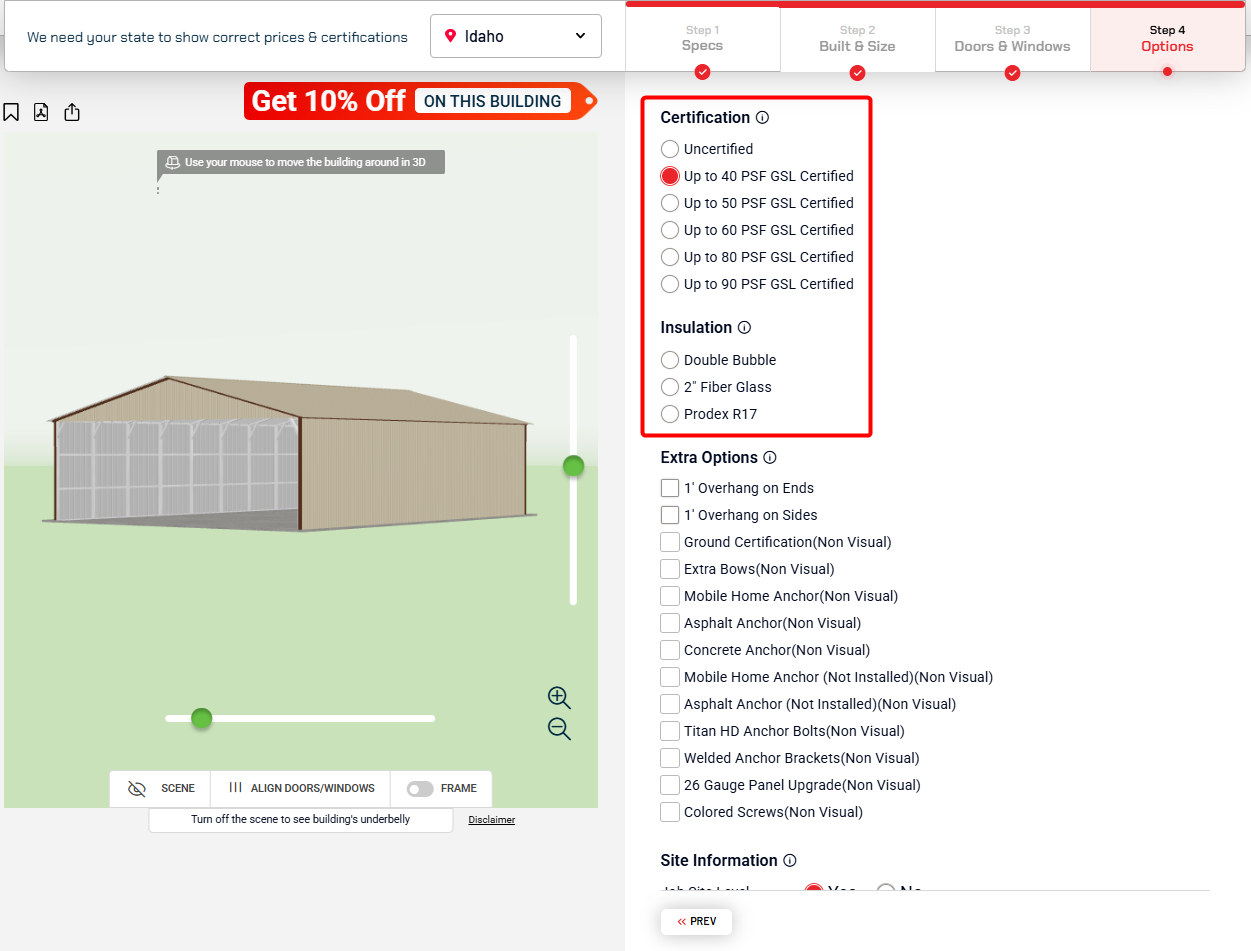
Metal buildings are built to last, but you can add more protection and comfort depending on how you plan to use the space.
You can order your building with a higher certification rating so it’s engineered to handle those tougher conditions. That rating isn’t just a number, it’s peace of mind that your structure is ready for what your climate throws at it.
Insulation is a smart upgrade if you will be working inside or storing sensitive items that are temperature-sensitive. It keeps summer heat out, brings warmth in during winter, and makes the building space more comfortable overall.
Upgrades include:
- Higher-rated certification — Up to 40 PSF or more, meeting strict building codes.
- Insulation options — Double Bubble for basic thermal control, 2-inch fiberglass for better coverage, or R17 Prodex for maximum efficiency.
Both options are easy to add during design. You’ll see exactly how they fit into your build before you finalize the order.
Transparent Pricing & Flexible Payment Options
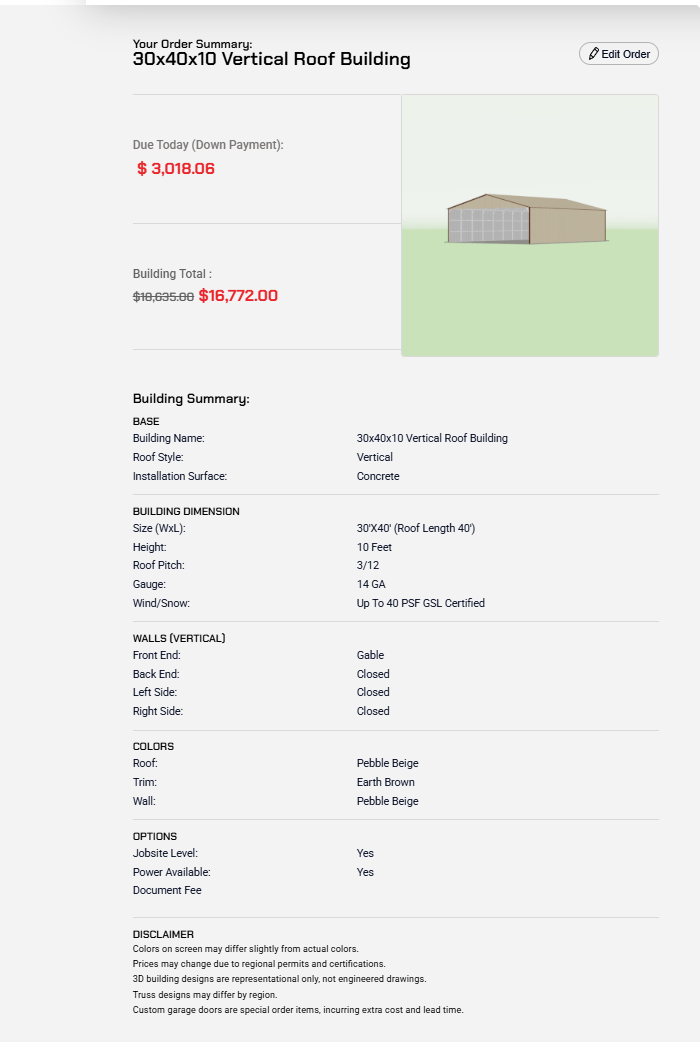
You’ll see the full cost of your building right away with no surprises later. This price covers the building itself, installation, and any extras you’ve chosen, like site preparation, color upgrades, or added structural features.
Paying is just as flexible. Put down a deposit or set up monthly financing. Choose what works best for your budget.
From time to time, seasonal discounted sales comes on site. On medium to larger structures, those discounts can really make a difference.
What you’ll notice:
- Clear breakdown – Every part of the order is itemized so you know exactly what you’re paying for.
- Different payment paths – Start with a deposit, or finance it over time.
- Discount opportunities – Watch for promotions, some going as high as 15% off.
The goal is simple: make buying your building straightforward from the very start.
Add-Ons to Make Your Building Work Better for You
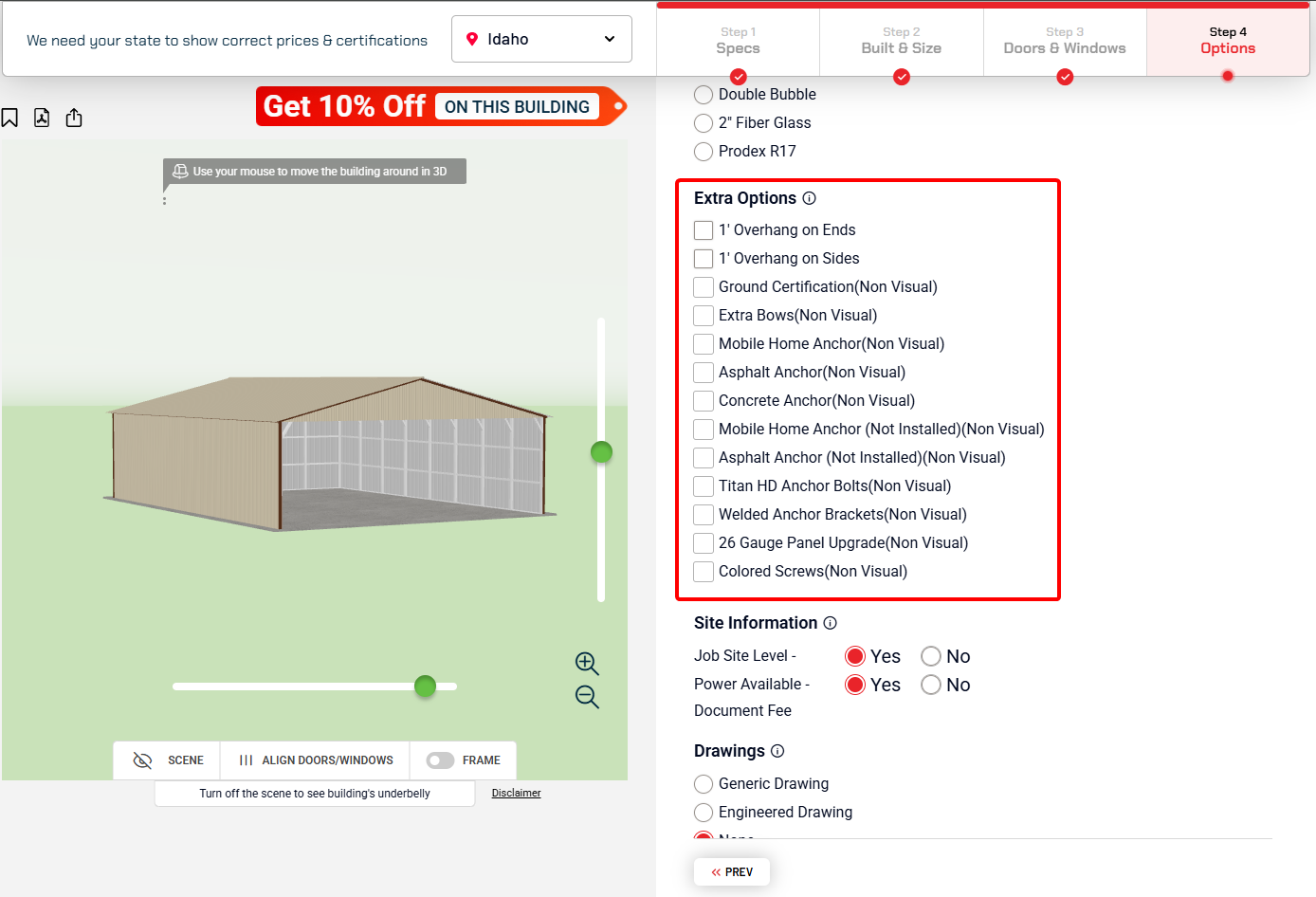
Every building starts with a solid base design. You can make upgrades that add strength, improve the design and looks, or extend its lifespan.
If you live in an area where winds hit hard, or you just want a durable setup, you can grab addons that include extra bows or mobile home anchors for added stability. Overhangs are another option - they provide additional coverage on the sides or ends and can alter the building's appearance.
You can also choose to add warranty coverage during checkout. That extra protection can help guard against rust-through or panel issues over time.
Some of the upgrades people often choose include:
- Extra structural support — Additional bows or anchors to reinforce the frame.
- Overhangs — Custom lengths on the sides or ends for more coverage and shade.
- Warranty coverage — Protection for rust and panel wear for longer peace of mind.
Not every project needs these, but in the right situations, they can be a smart addition.
Wrapping Up Your Order
Once your building design is set, the last step is quick. You’ll see a single page showing every choice you’ve made - size, roof style, colors, doors, windows, and any extras.
Take a moment to check it over. If it all looks good, click “Buy Now” and fill in the required details to lock in your order. Right after, you’ll get a confirmation of your order.
From design to checkout, it’s just a few clicks - and you’re done.
Here’s what you’ll get before you finish:
- Order summary – All the specs you picked, listed in one place for easy review.
- Confirmation details – Your delivery timeline and follow-up instructions so you know what to expect.
Visual Tools That Help You Decide
When you’re making a major purchase like this, seeing exactly what you’re getting matters. You want to be confident in your choices before committing — and the design tools make that possible.
You can view your building in 3D and spin it around to check every side. Change the colors. Swap features in or out. Zoom in to see the close details. The building images are sharp enough to show you the trim lines, roofing, and finishes clearly.
With these tools, you’re not guessing — you’re designing with your eyes open.
What’s available:
- 3D viewer – Rotate your design in real time while you build it.
- Detailed product images – See rooflines, trims, and doors up close before ordering.
- Live color selection – Switch colors instantly and preview the changes right away.
It’s the next best thing to standing in front of the finished building — without spending a dollar until you’re sure.
Customer Support & FAQ – Here When You Need Us
Questions happen. Sometimes it’s right at the start, before you’ve even picked a size. Other times it’s mid-checkout, when you want to double-check a detail.
You won’t be left figuring it out alone. We have an FAQ with straight, practical answers - from how to buy a metal building, how to tweak a design, to payment steps, what the lead time is, to what the installers will do on site. No long-winded explanations. Just what you need to know.
If you’d rather talk it through, use the live chat. You’ll be connected with someone who actually knows the process and can walk you through it without making you wait for an email reply.
Here’s what’s in place:
- Live chat – Quick connection to a support rep who can give you clear, direct help
- FAQ section – Plain answers on design options, payment methods, installation timelines, and more.
The help’s there. The moment you need it. So you can keep moving and get your building sorted without the guesswork.
Ready to Start?
Once you’ve had a look at the options, getting your design underway is straightforward. You can start right now, or step away and come back to it later — your progress will be waiting.
Everything is set up to keep the process simple. From customizing your building, to seeing the price update in real time, to checking out - it’s all built for flexibility.
Doesn’t matter if it’s a small backyard shed or a full-scale commercial build — the tools are ready when you are.
Click “Customize Your Building” and take the first step.

Frequently Asked Questions
The differences between attached and detached garages relate to access, climate control, and segregation. An attached garage offers direct access to the home, provides convenience, boasts superior climate control, and is usually less expensive to construct, though it can be noisy. A detached garage provides excellent segregation, making it perfect for noisy hobby areas or for creating rental apartments. Additionally, prefabricated metal detached garages can be ready in a matter of weeks, giving a significant advantage in construction lead time
Door dimensions are essential for the functionality of the entry and exit points.
For a 1-car garage, a 9-foot or 10-foot-wide door is recommended, with the 10-foot option making it much easier to pull the vehicle in.
For a 2-car garage, a 16-foot-wide door is standard, or you can opt for two separate 9-foot-wide doors. Regarding height, the standard is 7 feet, which is often too low for modern vehicles.
It is a smart upgrade to choose the recommended 8-foot door height, as this easily clears lifted SUVs, trucks with roof racks, and minivans
The ‘standard’ size for a 3-car garage is 32 feet by 22 feet. However, since many people drive trucks and SUVs, the source recommends upgrading to the Better/Recommended Size of 36 feet by 24 feet. The added width and depth of the 36’ x 24’ layout comfortably accommodates three larger vehicles and provides essential storage space. This size is ideal for bigger families, those who drive trucks, or anyone with growing hobbies
Depth is a crucial element for functionality; the sources state that the "magic of a great garage isn't its width—it's its depth". Planning for extra room behind where your bumper stops creates a "gold mine" of space, as forgetting about depth is the number one planning mistake.
This extra space is necessary because your garage functions as more than just a parking spot—it is also a storage hub and workshop. By adding a few extra feet, aiming for a total depth of 24 to 26 feet, you create a “buffer zone” at the front or back to accommodate essential items like bikes, lawnmowers, or holiday decorations
The absolute minimum size for a 2-car garage is 20 feet by 20 feet, though this results in a tight squeeze where you must climb out carefully to avoid dinging doors. The recommended or comfortable size is 24 feet by 24 feet, as this size works harder and is ideal for families needing additional storage. An intermediate size, 22 feet by 24 feet, is also considered a significant improvement, offering more shoulder room between vehicles and being labeled a “Family’s Favorite” that works for real life


