




- Key Things to Know Upfront
- Why Permits are Tougher Out West
- State-By-State Overview (Western U.S.)
- A Closer Look at Each State
- What “Permit-Ready” Actually Means
- Risk Category II and Why It Matters
- What We Provide for Certified Orders
- Questions to Ask Before You Buy
- Final Thoughts


So you’ve picked your metal building size, maybe even started picturing where it’s going to sit on your property. Then the permit question shows up, and it’s usually where things start to feel less straightforward.
Across the Western U.S., there isn’t one clean answer. Not even close. A setup that goes up easily in rural Montana might need engineered drawings, multiple approvals, and zoning checks in California. Even within the same state, rules can change from one county to the next.
This guide is here to help you get a realistic sense of what to expect, state by state, plus what “permit-ready” actually means when you’re ordering a metal building.
Key Things to Know Upfront
- Permit rules aren’t consistent across the West. Most states fall somewhere between 120 and 200 sq. ft. before permits kick in, but zoning and agricultural rules can change that quickly.
- California, Oregon, and Washington tend to be the strictest. That’s mostly due to seismic requirements plus snow and wind loads. Montana and Wyoming are on the opposite end. Some counties barely enforce permitting at all, especially in rural areas.
- Permit-ready isn’t just a marketing term. It usually means your building includes engineer-stamped drawings that match your local wind, snow, and seismic conditions.
- Enclosed or occupied buildings, including many metal garages, almost always get more scrutiny than open carports.
- If you’re unsure, we can provide stamped drawings when required. Just call 208-572-1441 before you order so you’re not guessing.
Not sure if your county needs stamped drawings? Call 208-572-1441 before you order. We’ll help you understand what details may be needed for your building size, location, and intended use.
Why Permits are Tougher Out West
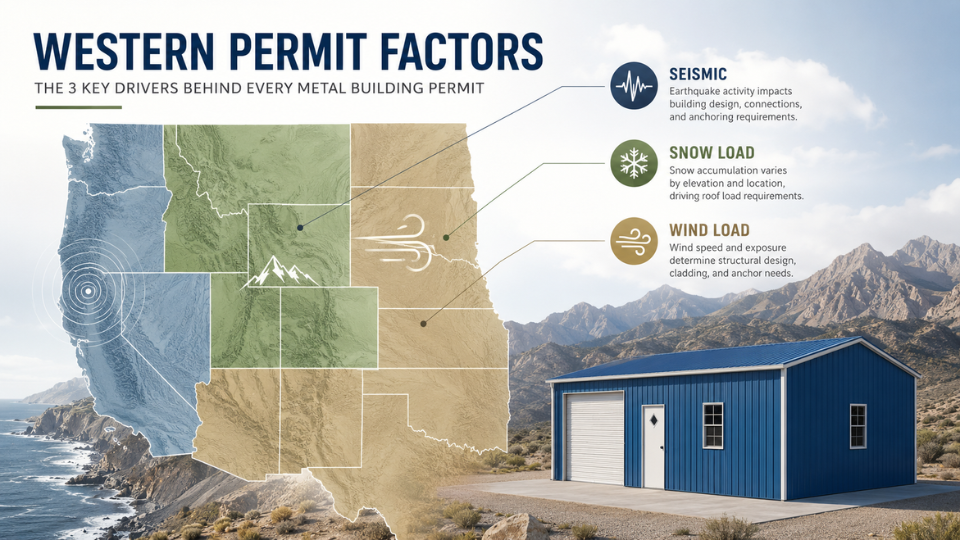
The West deals with a mix of extremes you don’t always see elsewhere. Earthquakes, heavy mountain snow, high desert winds, and everything in between. That’s really what drives most of the rules.
Seismic zones change everything in coastal states
California, western Oregon, and western Washington sit near major fault systems, including the Cascadia Subduction Zone. That alone pushes stricter building standards.
Because of that risk, counties require structures to be engineered for lateral movement, basically, how a building holds up during shaking. That’s why stamped engineering drawings are so common in those areas.
If you’re building in places like the Bay Area, Puget Sound, or the Willamette Valley, expect a permit and expect engineering.
Snow And Wind Loads are Highly Local
In Colorado, some mountain counties can exceed 100 PSF snow loads. In Wyoming, wind is often the bigger issue than snow. In Arizona, it’s monsoon winds that catch people off guard.
These numbers directly affect how your building is designed and framed. That’s why certified metal buildings matter, as they’re built to match the exact load requirements for your site, not a generic average.
Agricultural Exemptions Exist, But Don’t Assume Them
Most western states do offer agricultural exemptions, but they’re not universal and they’re not automatic.
They usually apply only if:
- The structure is on actively farmed land
- It’s used for agriculture, such as metal barns, equipment storage, or livestock
- It’s not used as a residence, office, or commercial workspace
- It’s outside city limits or certain zoning areas
If you’re on farmland in places like eastern Washington or rural Nevada, it’s worth checking. Just don’t assume exemption until the county confirms it.
State-By-State Overview (Western U.S.)
This is a general snapshot. Counties can, and often do, override these baselines. You can also review our service areas to connect your project with the right state-level building context.
| State | Permit Need | Typical Threshold | Main Design Concern | Ag Exemption |
|---|---|---|---|---|
| California | Almost always | Nearly all roofed structures | Seismic + coastal wind | Limited |
| Oregon | Yes | 200+ sq ft | Seismic west / snow east | Yes (farm use) |
| Washington | Yes | 200+ sq ft | Seismic + snow | Yes (qualified farms) |
| Arizona | Depends | 200+ sq ft in cities | Wind + mountain snow | Yes (rural areas) |
| Nevada | Varies | County-based | Seismic west / snow north | Yes (rural) |
| Colorado | Yes | ~120+ sq ft | Heavy snow loads | Yes (ag land) |
| Utah | Yes | 200+ sq ft | Snow + seismic (Wasatch) | Yes |
| Idaho | Varies | Often exempt ag structures | Snow loads | Strong exemption |
| Montana | Often not required | Many rural areas unregulated | Snow loads | Yes |
| Wyoming | Limited | No statewide code | Extreme wind | Yes |
| New Mexico | Yes | County-based | Wind + elevation snow | Yes (rural) |
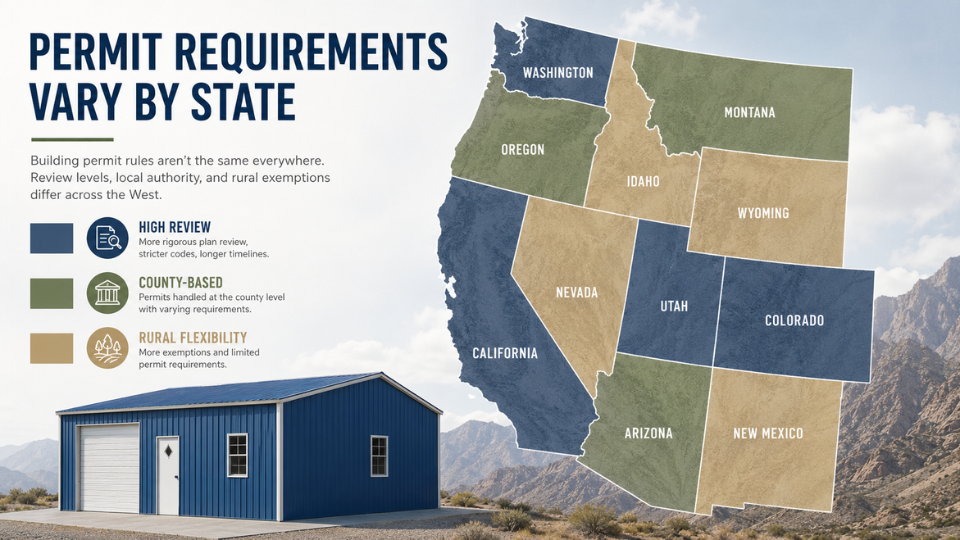
A Closer Look at Each State
California
California is the most regulated state in the West. Between Title 24 and local amendments, nearly everything requires a permit if it has a roof.
Seismic rules drive most of it. Even simple buildings often need engineered drawings. Agricultural exemptions exist, but they vary a lot by county and aren’t always easy to navigate.
Oregon
Western Oregon deals with seismic risk, while eastern Oregon deals more with snow.
The state sets baseline rules, but counties enforce them differently. Agricultural exemptions exist for real farming operations, but you’ll want confirmation before assuming anything.
Washington
Western Washington is strict. Seattle, Tacoma, and surrounding counties require permits for most structures over 200 sq. ft.
Eastern Washington is less seismic but still sees heavy snow in certain regions.
Farm structures can qualify for exemption, but only if they’re actually used for agriculture.
Arizona
There is a big difference between metro and rural areas. Phoenix and Tucson-area counties enforce standard permit rules. Rural counties are far looser. Areas like Flagstaff must contend with snow loads.
Nevada
Clark County (Las Vegas) and Washoe County (Reno) follow stricter building codes.
Rural Nevada is much more relaxed, especially in agricultural zones. Still, “minimal regulation” doesn’t mean no regulation, so it’s worth confirming locally.
Colorado
Colorado is all about elevation. Mountain counties deal with extremely high snow loads, sometimes over 100 PSF. Front Range areas follow standard codes but still require permits.
Agricultural exemptions exist but only apply to legitimate farm use.
Utah
The Wasatch Front is the strict zone as Salt Lake City and nearby counties enforce strong seismic and snow load requirements. Rural counties are more flexible, but still follow basic safety standards.
Idaho
Idaho is popular for metal buildings because of its strong agricultural exemption. Many farm-related structures don’t require permits, but snow loads still matter for design.
Montana
Montana is one of the most relaxed states when it comes to permits, especially in rural counties. But snow loads are serious. Even without a permit requirement, engineering still matters here.
Wyoming
Wyoming has no statewide building code. Rural areas often have minimal oversight, but wind is the real challenge here. Some of the strongest sustained winds in the country happen in this state.
New Mexico
New Mexico varies a lot by region. Northern areas deal with snow, while the eastern plains deal with wind. Agricultural exemptions exist but depend on zoning and county rules.
Planning in a high-snow, high-wind, or seismic area? Call 208-572-1441 before choosing your final size. A short call can help you avoid building specs that do not match your county’s requirements.
What “Permit-Ready” Actually Means
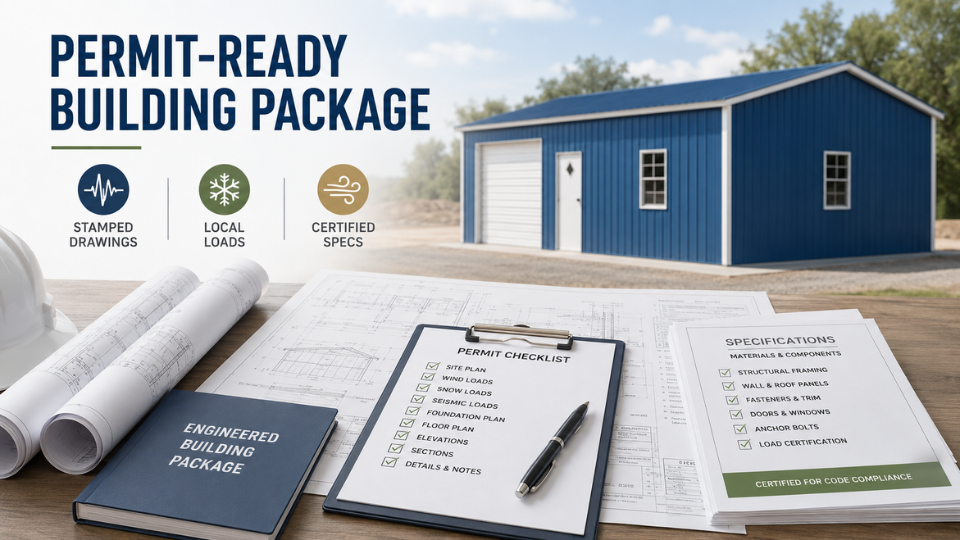
A standard drawing just shows how the building is assembled. A stamped drawing means a licensed engineer has reviewed the design and confirmed it meets your local wind, snow, and seismic requirements.
Most counties won’t accept anything less for approval.
Risk Category II and Why It Matters
Most garages, barns, and workshops fall under Risk Category II. That just means the structure is expected to be occupied by humans and made to handle typical environmental loads safely.
Once a building is enclosed or regularly used, this classification almost always applies.
What We Provide for Certified Orders
When your project needs certification, we supply engineer-stamped drawings matched to your location’s specific requirements. Our metal buildings use 14-gauge framing and 29-gauge panels, with documentation prepared for permit submission when needed.
If you’re unsure what your county will require, call 208-572-1441 before ordering. It can save a lot of back-and-forth later.
Need a certified building example? Review the 20x20x12 Certified Building with Lean Tos, then call 208-572-1441 to discuss what your county may require before you order.
Questions to Ask Before You Buy
Before you order anything, it helps to get clarity on a few basics:
- Do I actually need a permit for this size building?
- Does my zoning allow agricultural exemptions?
- Will stamped drawings be required?
- Are there setback rules I need to follow?
- Any height restrictions?
- Can permits be submitted online?
Most counties can answer all of this in one quick phone call.
Final Thoughts
Permitting in the West isn’t uniform, and it probably never will be. The best move is always the same: check with your county before you commit to a size or layout.
Once you know your requirements, we can match the building to them, engineered, stamped, and ready for approval where needed.
Ready to get started? You can design your structure with the 3D Building Designer or call 208-572-1441 for more information on permitting requirements in your area.
Ready to plan your permit-ready structure? Use the 3D Building Designer to map out your building size and layout, then call 208-572-1441 if you need help with certified building options.
- Key Things to Know Upfront
- Why Permits are Tougher Out West
- State-By-State Overview (Western U.S.)
- A Closer Look at Each State
- What “Permit-Ready” Actually Means
- Risk Category II and Why It Matters
- What We Provide for Certified Orders
- Questions to Ask Before You Buy
- Final Thoughts


Frequently Asked Questions
Yes, but it’s better to at least start the permit process first. Call 208-572-1441 to coordinate timing.
Anywhere from a week in rural counties to several months in stricter metro areas.
In most cases, yes—but some commercial or complex builds require a contractor.
If your building isn’t designed for the required snow load, the permit won’t be approved in many counties.
Sometimes yes, sometimes no. California and Colorado often require them, even for open structures.
It means the building is engineered and stamped for your site’s wind, snow, and seismic conditions.
Not always. Rural and agricultural areas in states like Montana, Idaho, and Wyoming often have exemptions. But cities and occupied buildings usually require permits.


