



- Key highlights
- Why Idaho permit pricing feels confusing
- What “permit cost” usually includes in Idaho
- Real Idaho fee examples, so you can budget smarter
- What Idaho permit offices usually want in your plan set
- For homeowners, the small-building exemption usually does not solve the real problem
- For farmers, “ag exempt” still needs careful review
- What drives plan costs higher on a metal building in Idaho
- The biggest mistakes I see Idaho buyers make
- My practical advice before you order a metal building in Idaho
- How EMB can help you stay ahead of the Idaho permit process
- Conclusion


If you call me and say, “I just want a metal garage, shop, barn, or farm building in Idaho. What will the permit cost?”, my honest answer is this: there is no single Idaho number. Idaho uses statewide adopted building codes, but permits are enforced locally, and local jurisdictions can amend certain provisions for local concerns. That is why the same steel building can price and review differently in Boise, Canyon County, Idaho Falls, or a rural county.
Key highlights
-
Idaho follows statewide adopted building codes, including the 2018 International Building Code, 2018 International Residential Code, and 2018 International Energy Conservation Code, but local governments handle permitting.
-
Permit cost is usually not one fee. It can include an application fee, building permit fee, plan review fee, engineering, foundation design, and sometimes separate site, fire, grading, or reinspection charges.
-
Idaho jurisdictions commonly require engineered plans for metal buildings. Ada County says all steel buildings must be engineered, including foundation design, and Canyon County says all metal or steel structures require engineering plus an engineered foundation plan..
-
Small shed exemptions exist in some places, but they usually do not help with full-size metal garages, RV covers, barns, or workshops. In Nampa, for example, the detached storage-building exemption is under 200 square feet and under 12 feet tall, and any permanent electrical, plumbing, or HVAC still triggers permit requirements.
-
Agricultural buildings can be exempt in Idaho, but “exempt” does not always mean “no paperwork.” Idaho law allows counties to require permits for setbacks and utility easements, and counties like Minidoka and Lemhi still require siting or site-related review for qualifying ag structures.
Why Idaho permit pricing feels confusing
The first thing to understand is that Idaho is a statewide code state, but not a one-price state. The state has adopted the core codes, yet local governments issue permits and perform enforcement. Idaho law also lets local jurisdictions amend certain provisions to address local concerns, which is why design expectations can shift from one county or city to the next.
That matters in real life. A metal shop in a lower-snow valley location may not face the same structural questions as a similar building in a mountain county. The shell size might be identical, but site conditions, local design criteria, setbacks, drainage, snow, wind, and fire-related review can change what your permit office wants to see and what it charges to review.
What “permit cost” usually includes in Idaho
When customers say “permit cost,” they are usually mixing together several different expenses. That is where budgets go sideways.
1) Application or intake fees
Some jurisdictions charge an upfront filing fee just to start the process. Kootenai County , for example, lists a non-refundable permit application fee of $141. Canyon County also uses a plan review deposit, and once staff has reviewed the plans, that deposit is not refundable.
2) Building permit fee
Many Idaho jurisdictions base the permit fee on project valuation, not just building size. Boise’s building fee schedule is valuation-based, and Canyon County says valuation includes the total value of construction work plus finish work, roofing, electrical, plumbing, heating, air conditioning, fire-extinguishing systems, and other permanent equipment. That means every add-on can affect the permit math.
3) Plan review fee
This is where buyers get surprised. In Boise, commercial building plan review is 65% of the building permit fee, while residential plan review for one- and two-family dwellings, townhouses, and accessory structures is 20% of the building permit fee. Canyon County uses a different structure: 16% of the building permit fee for one- and two-family dwellings and accessory structures, and 65% for other occupancy uses. Idaho Falls also lists separate site plan review and structural plan review fees.
4) Engineering and stamped plans
For metal buildings, your plan cost often starts before the permit office even touches the file. Ada County says all steel buildings are required to be engineered, including a foundation design. Canyon County says all metal or steel structures require engineering for the structure and an engineered foundation plan. In other words, a basic sketch is usually not enough for a real steel building permit package.
5) Extra reviews, revisions, and inspections
Permit offices may charge more if you revise the plans, fail inspection, or start work too early. Boise charges hourly fees for additional plan review after the third review or when modifications are made after permit issuance, and it also charges a special investigation fee equal to 100% of the permit fee for work that starts before a permit is issued. Boise also lists reinspection fees.
Real Idaho fee examples, so you can budget smarter
Here is the practical takeaway: do not trust one statewide dollar figure you found in a forum or on social media. Idaho’s official local schedules already show why that approach fails.
-
Boise: building permit fees are valuation-based; residential plan review is 20% of permit fee, commercial plan review is 65%, and additional review or revisions can add hourly charges.
-
Canyon County: valuation includes more than the shell, there is a $180 plan review deposit for new dwellings and commercial structures, residential and accessory plan review is 16%, and other occupancy uses are 65%.
-
Idaho Falls: site plan review is listed at $70, and structural plan review is listed at $0.16 of building permit valuation.
-
Kootenai County: the permit application fee is $141 and non-refundable.
So when I talk to a customer in Idaho, I tell them to separate the budget into three buckets: jurisdiction fees, engineering and plan-set costs, and site or foundation costs. That gives you a much more realistic number than asking, “What does the permit cost?”
What Idaho permit offices usually want in your plan set
A lot of permit delays happen because the buyer has a building quote, but not a permit-ready package.
Boise’s accessory-structure checklist is a good example of what many Idaho permit offices expect: site plan, floor plan, foundation plan, roof framing information, wall sections, elevations, footing details, anchor details, and distances to property lines and nearby structures.
That is a big deal in the metal building world, because plenty of garages, workshops, RV covers, and equipment sheds go over 10 feet in wall height. If your building is tall, wide-span, customized, or outside prescriptive wood-framing rules, plan cost goes up because the engineering burden goes up.
For homeowners, the small-building exemption usually does not solve the real problem
Some buyers hear “under 200 square feet” and assume they can skip permits. Sometimes that is true for very small detached storage structures, but it is not a shortcut for most metal building projects.
In Nampa, the exemption listed for detached storage buildings is less than 200 square feet and not over 12 feet in height. Nampa also says any accessory structure of any size needs a permit and approved permanent footing or foundation if it has permanent electrical wiring, plumbing, or HVAC. So even a smaller building can move back into permit territory once utilities or a permanent foundation enter the picture.
That is why this exemption rarely helps with what most Idaho buyers actually want, such as a metal garage, enclosed workshop, livestock shelter with utilities, RV cover, or a storage building with real long-term use.
For farmers, “ag exempt” still needs careful review
Idaho law says local governments must exempt agricultural buildings from the building codes covered in that chapter, but counties may still issue permits for farm buildings to confirm road setbacks and utility easements, and the cost of those permits cannot exceed the actual cost to the county of issuing them.
Minidoka County is a good example. It says a qualifying agricultural building is exempt from a full building permit, but the owner still needs a Siting Permit in place of a full building permit to address setbacks and siting.
Lemhi County goes further and makes the limits very clear. Its ag exemption packet says exempt ag buildings cannot be used for human habitation, public use, a personal-use garage, or a machinery repair shop. It also says ag buildings must still conform with minimum snow, wind, frost, seismic, and other engineering requirements for safety, and the owner must obtain a site permit.
Madison County’s 2025 ag-exempt application also notes a minimum review period of ten working days after a complete submittal. So even when a building qualifies as agricultural, it is still smart to budget time for review and not assume same-day approval.
Here is the simplest way I explain it to Idaho farmers:
-
A hay shed or equipment shelter on true ag land may qualify for exemption.
-
A personal garage, public-use building, repair shop, or habitable space usually does not qualify.
-
Even exempt ag buildings may still need site placement review, setbacks, and safety-related engineering.
What drives plan costs higher on a metal building in Idaho
This is the part I want every buyer to understand before ordering.
Building height and span
Taller walls, wider spans, and custom openings usually mean more engineering. Boise calls out engineering for accessory structures with walls over 10 feet.
Foundation design
A lot of buyers think the building package is the whole story. It is not. Idaho jurisdictions commonly want foundation information, and Ada County specifically says steel buildings require engineering including foundation design.
Site conditions
Setbacks, floodplain conditions, grading, drainage, and overlay requirements can create extra drawings and extra review.
Plan revisions
Late changes cost money. Boise charges hourly fees for additional plan review after repeated reviews or post-issuance plan changes.
The biggest mistakes I see Idaho buyers make
- Buying the building before checking the site.
A perfect building on the wrong parcel still becomes a permit headache. Setbacks, access, floodplain, and local overlays matter.
- Assuming the shell quote includes a permit-ready foundation package.
Many Idaho offices want structural and foundation engineering. Confirm it early.
- Using the wrong engineer stamp.
Canyon County says it does not accept out-of-state engineering stamps for plans that require engineering.
- Assuming “ag exempt” covers everything rural.
It does not. Use matters, zoning matters, and counties may still require siting review.
- Starting work before the permit is issued.
That can trigger major extra charges. Boise’s special investigation fee is a good reminder of that risk.
My practical advice before you order a metal building in Idaho
Before you place the order, get answers to these five questions:
-
Is my building classified as residential accessory, agricultural, commercial, or something else?
-
Does my jurisdiction want full engineered plans, an engineered foundation plan, or both?
-
Are there site issues, like setbacks, grading, floodplain, wildfire area, or drainage, that trigger extra review?
-
Will my engineer stamp need to be from an Idaho licensed engineer?
-
What will I pay separately for application fees, plan review, inspections, and revisions?
That five-question check will save you more time and money than chasing a random statewide “average permit cost.”
How EMB can help you stay ahead of the Idaho permit process
At Engineered Metal Buildings, the smart move is to design the building around your actual location and intended use, not around a generic online price. EMB’s product setup is built around customizable pre-engineered steel buildings, a 3D Building Designer, and location-sensitive pricing.
We also point buyers to resources for site prep, snow and wind loads, ordering process, and FAQs, which is exactly the kind of prep work that helps before permit submittal.
Conclusion
If you remember one thing, remember this: metal building permit and plan costs in Idaho are local, layered, and heavily affected by engineering requirements.
The building permit fee is only one piece. Real Idaho costs can also include application fees, plan review percentages, site-plan review, structural review, engineered drawings, foundation design, and revision charges.
So before you buy, match the building to your parcel, your use, and your jurisdiction. Then get your quote, engineering, and permit path lined up in that order. That is how you keep an Idaho metal building project moving without expensive surprises.
FAQs
Do metal buildings need a permit in Idaho?
Yes, in most cases. Idaho follows the International Building Code, and any permanent structure used for commercial, industrial, or residential purposes will require a building permit.
How much is a metal building permit in Idaho?
Permit fees vary widely by jurisdiction and are typically calculated based on the total valuation of the project.
What is the difference between a permit fee and a plan review fee?
A permit fee covers the cost of inspections during and after construction. A plan review fee is a separate charge for the time it takes a building official to review your submitted drawings and engineering documents before a permit is issued.
Do agricultural metal buildings need permits in Idaho?
Idaho has exemptions for certain agricultural structures, particularly those used for farming, ranching, and storage of equipment or livestock on working agricultural land. However, the exemption has conditions and doesn't apply universally.
Can I use plans stamped by an out-of-state engineer?
Idaho does not automatically accept stamps from engineers not licensed in Idaho.
Can I put up a small metal shed in Idaho without a permit?
Possibly. Many Idaho jurisdictions exempt small accessory structures
Similar Building Models


- Key highlights
- Why Idaho permit pricing feels confusing
- What “permit cost” usually includes in Idaho
- Real Idaho fee examples, so you can budget smarter
- What Idaho permit offices usually want in your plan set
- For homeowners, the small-building exemption usually does not solve the real problem
- For farmers, “ag exempt” still needs careful review
- What drives plan costs higher on a metal building in Idaho
- The biggest mistakes I see Idaho buyers make
- My practical advice before you order a metal building in Idaho
- How EMB can help you stay ahead of the Idaho permit process
- Conclusion


You don’t have to spend weekends driving from one dealer to another or wait days for someone to call you back. These days, you can buy your metal building without ever leaving home.
The process is online now. Faster. More flexible. And you stay in control from start to finish.
Planning a workshop? Need a garage? Maybe a barn? Ordering online saves time, often saves money, and gives you far more options than most local suppliers can offer.
Why More People Are Buying Online
- Shop whenever it works for you.
- Find better deals, with discounts only offered online.
- See more choices in styles, sizes, and layouts than you’d find in person.
Once you start designing, everything’s laid out clearly. Change the size. Switch the roof style. Test out different colors. Every option is right in front of you. When it looks the way you want, you can place your order on your schedule, no pressure, no waiting.
Seamless Online Shopping Experience
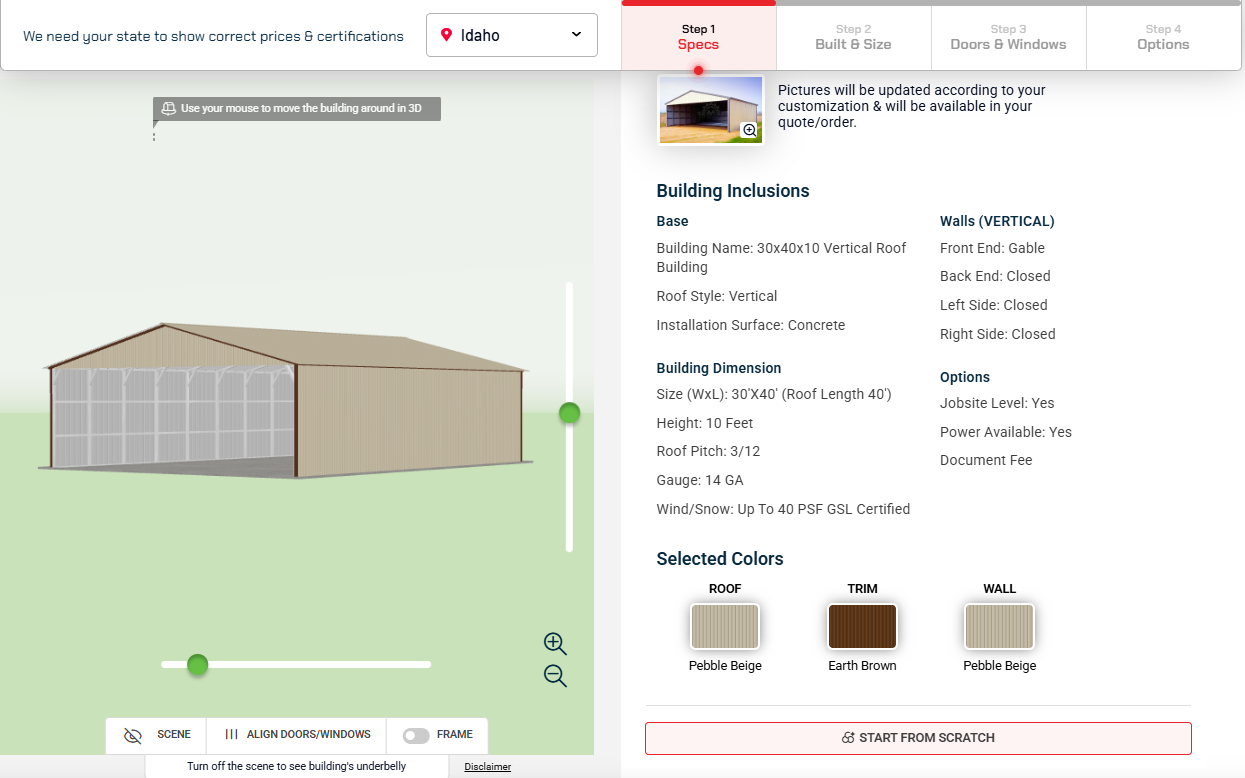
Our e-commerce platform is designed to guide you through the process step by step. First, you choose the type of building you need. From there, every option is user-friendly and clearly builds size, lean-tos, roof style, doors, windows, all with live pricing as you make changes. And when you’re done, the checkout is fast. No forms that ask for the same thing twice. No waiting around.You’ll also be able to follow your progress, from start to confirmation.
What stands out:
- The layout is clear, so you know exactly where to begin.
- Prices update instantly as you change features.
- The entire order process only takes a few minutes once you’re ready
Fully Customizable Metal Buildings
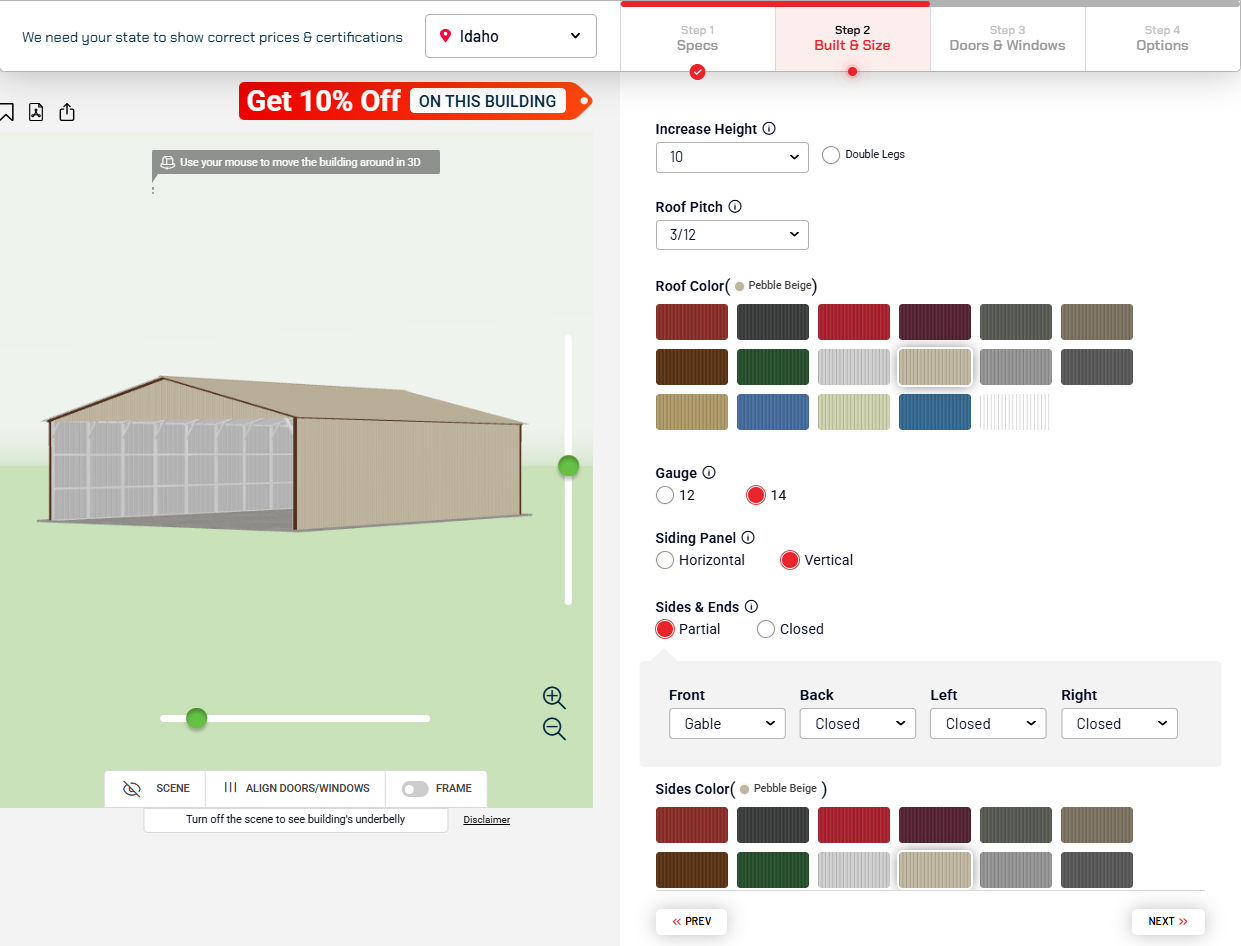
Ordering a metal building online isn’t just convenient; it lets you make it exactly how you want it. No sticking to a handful of pre-set models. No “close enough” designs. You can start small with a backyard shed or go big with a commercial building, and everything in between.
From the first click, you’re in control. Change the size. Pick your roof style. Add the number of doors and windows you need. Adjust the colors until they fit your property perfectly. As you make changes, you’ll see the updates instantly on your screen.
There’s also a 3D design tool built in. You can spin your building around, zoom in on the details, and get a clear picture of what it’ll look like before you place the order.
Want specifics? You can choose dimensions like 30×40 or 40×60, or type in your own measurements. Go vertical or regular on the roof. Match the roof, wall, and trim colors to your taste. Add the right openings, frame reinforcements, or both. And with the live 3D view, you’ll see your vision take shape right in front of you.
Certification & Insulation – Built for Where You Live
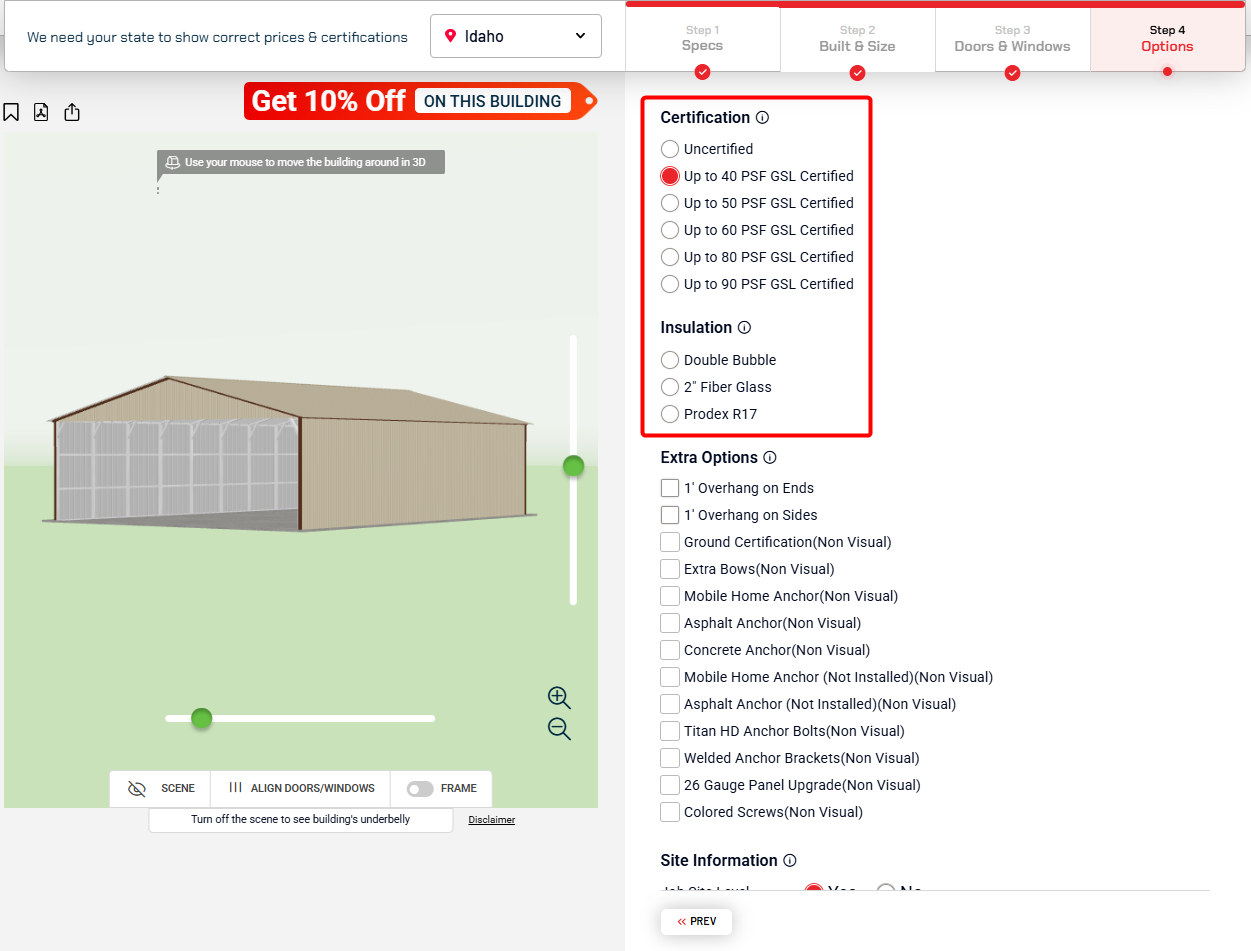
Metal buildings are built to last, but you can add more protection and comfort depending on how you plan to use the space.
You can order your building with a higher certification rating so it’s engineered to handle those tougher conditions. That rating isn’t just a number, it’s peace of mind that your structure is ready for what your climate throws at it.
Insulation is a smart upgrade if you will be working inside or storing sensitive items that are temperature-sensitive. It keeps summer heat out, brings warmth in during winter, and makes the building space more comfortable overall.
Upgrades include:
- Higher-rated certification — Up to 40 PSF or more, meeting strict building codes.
- Insulation options — Double Bubble for basic thermal control, 2-inch fiberglass for better coverage, or R17 Prodex for maximum efficiency.
Both options are easy to add during design. You’ll see exactly how they fit into your build before you finalize the order.
Transparent Pricing & Flexible Payment Options
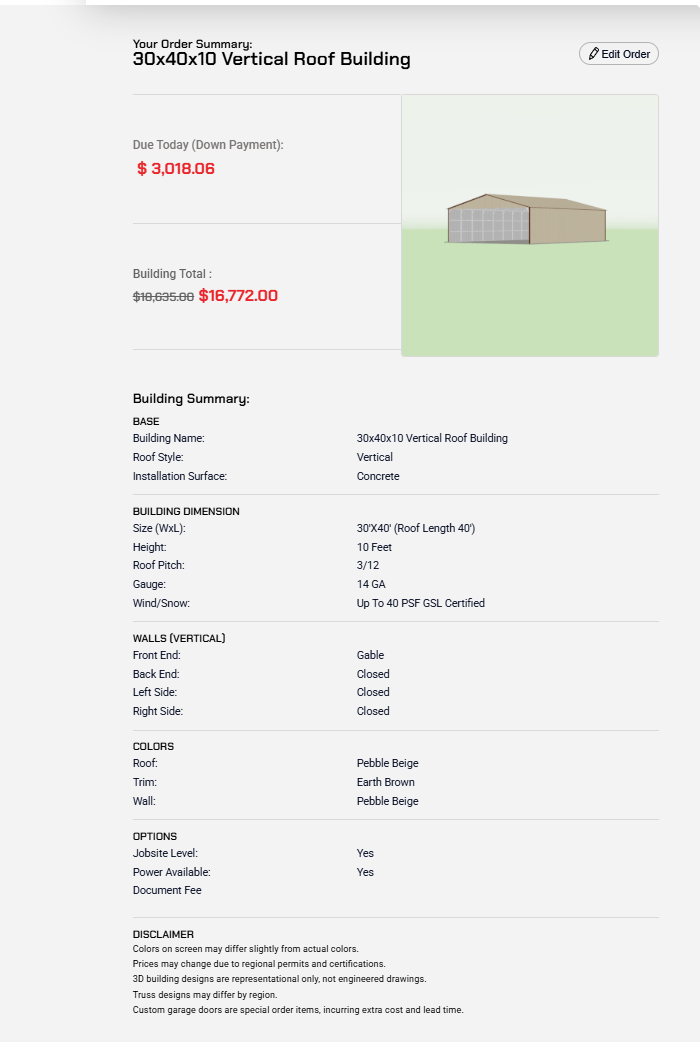
You’ll see the full cost of your building right away with no surprises later. This price covers the building itself, installation, and any extras you’ve chosen, like site preparation, color upgrades, or added structural features.
Paying is just as flexible. Put down a deposit or set up monthly financing. Choose what works best for your budget.
From time to time, seasonal discounted sales comes on site. On medium to larger structures, those discounts can really make a difference.
What you’ll notice:
- Clear breakdown – Every part of the order is itemized so you know exactly what you’re paying for.
- Different payment paths – Start with a deposit, or finance it over time.
- Discount opportunities – Watch for promotions, some going as high as 15% off.
The goal is simple: make buying your building straightforward from the very start.
Add-Ons to Make Your Building Work Better for You
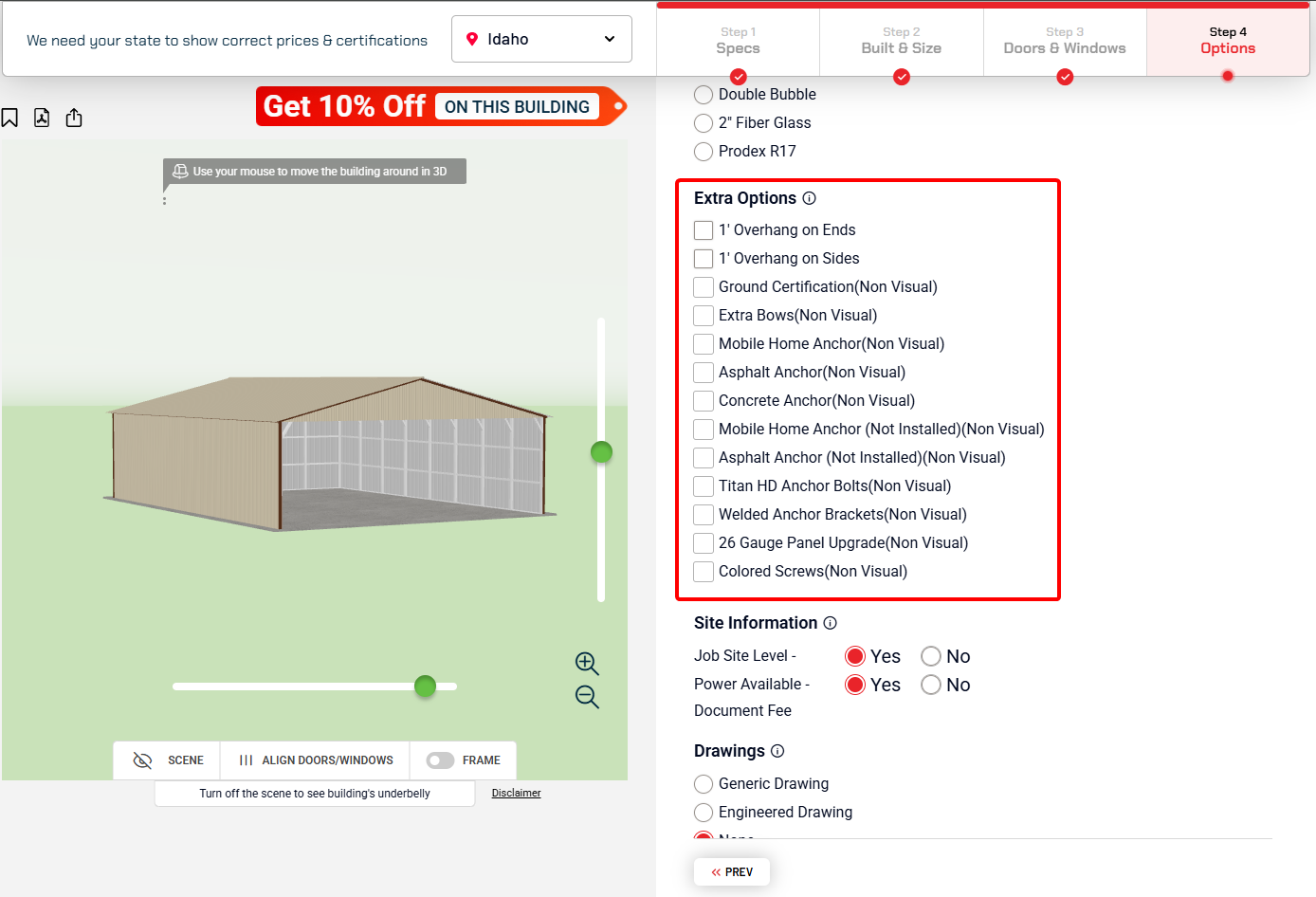
Every building starts with a solid base design. You can make upgrades that add strength, improve the design and looks, or extend its lifespan.
If you live in an area where winds hit hard, or you just want a durable setup, you can grab addons that include extra bows or mobile home anchors for added stability. Overhangs are another option - they provide additional coverage on the sides or ends and can alter the building's appearance.
You can also choose to add warranty coverage during checkout. That extra protection can help guard against rust-through or panel issues over time.
Some of the upgrades people often choose include:
- Extra structural support — Additional bows or anchors to reinforce the frame.
- Overhangs — Custom lengths on the sides or ends for more coverage and shade.
- Warranty coverage — Protection for rust and panel wear for longer peace of mind.
Not every project needs these, but in the right situations, they can be a smart addition.
Wrapping Up Your Order
Once your building design is set, the last step is quick. You’ll see a single page showing every choice you’ve made - size, roof style, colors, doors, windows, and any extras.
Take a moment to check it over. If it all looks good, click “Buy Now” and fill in the required details to lock in your order. Right after, you’ll get a confirmation of your order.
From design to checkout, it’s just a few clicks - and you’re done.
Here’s what you’ll get before you finish:
- Order summary – All the specs you picked, listed in one place for easy review.
- Confirmation details – Your delivery timeline and follow-up instructions so you know what to expect.
Visual Tools That Help You Decide
When you’re making a major purchase like this, seeing exactly what you’re getting matters. You want to be confident in your choices before committing — and the design tools make that possible.
You can view your building in 3D and spin it around to check every side. Change the colors. Swap features in or out. Zoom in to see the close details. The building images are sharp enough to show you the trim lines, roofing, and finishes clearly.
With these tools, you’re not guessing — you’re designing with your eyes open.
What’s available:
- 3D viewer – Rotate your design in real time while you build it.
- Detailed product images – See rooflines, trims, and doors up close before ordering.
- Live color selection – Switch colors instantly and preview the changes right away.
It’s the next best thing to standing in front of the finished building — without spending a dollar until you’re sure.
Customer Support & FAQ – Here When You Need Us
Questions happen. Sometimes it’s right at the start, before you’ve even picked a size. Other times it’s mid-checkout, when you want to double-check a detail.
You won’t be left figuring it out alone. We have an FAQ with straight, practical answers - from how to buy a metal building, how to tweak a design, to payment steps, what the lead time is, to what the installers will do on site. No long-winded explanations. Just what you need to know.
If you’d rather talk it through, use the live chat. You’ll be connected with someone who actually knows the process and can walk you through it without making you wait for an email reply.
Here’s what’s in place:
- Live chat – Quick connection to a support rep who can give you clear, direct help
- FAQ section – Plain answers on design options, payment methods, installation timelines, and more.
The help’s there. The moment you need it. So you can keep moving and get your building sorted without the guesswork.
Ready to Start?
Once you’ve had a look at the options, getting your design underway is straightforward. You can start right now, or step away and come back to it later — your progress will be waiting.
Everything is set up to keep the process simple. From customizing your building, to seeing the price update in real time, to checking out - it’s all built for flexibility.
Doesn’t matter if it’s a small backyard shed or a full-scale commercial build — the tools are ready when you are.
Click “Customize Your Building” and take the first step.
Frequently Asked Questions
Possibly. Many Idaho jurisdictions exempt small accessory structures.
Idaho does not automatically accept stamps from engineers not licensed in Idaho.
Idaho has exemptions for certain agricultural structures, particularly those used for farming, ranching, and storage of equipment or livestock on working agricultural land. However, the exemption has conditions and doesn't apply universally.
A permit fee covers the cost of inspections during and after construction. A plan review fee is a separate charge for the time it takes a building official to review your submitted drawings and engineering documents before a permit is issued.
Permit fees vary widely by jurisdiction and are typically calculated based on the total valuation of the project.
Yes, in most cases. Idaho follows the International Building Code, and any permanent structure used for commercial, industrial, or residential purposes will require a building permit.


